Services for High Net Worth Investors and Family Offices

Case Study B Longstanding Brokerage Links

Situation

  • A family office came to Manager Analysis via a referral from a Family Office that we assist. The family leader had managed wealth carefully, and he benefited from the stock market’s long-term performance. However, because he had kept portfolio management considerations away from his children, and because the entire family wanted to plan for an orderly transition of responsibilities, the family asked Manager Analysis to review the family’s portfolios and identify any material threats to the assets.
  • The next generation was generally pleased with their current holdings, comprised primarily of liquid, larger cap equities, and muni bonds, and they did not want to alter the strategy. They also valued their operationally conservative profile and comparably simple legal structures. Virtually all of the assets were held directly and so the family was in a good position to control the timing of transactions to avoid unnecessary capital gains taxes.

Findings

  • The broker was attempting to gain discretionary control of the family’s portfolio through sleight of hand.
  • Buried within a simple “principal transactions agreement” was a commitment for the family to a second agreement, granting the broker full discretion. The family did not to sign the form because of our strongly delivered advice.
  • While portfolio turnover was low, the broker was charging commissions of 1% to 2% on large stock trades. He was seeking the opportunity to liquidate the entire estate’s liquid holdings to receive a $1 million commission. Comparable commissions would be about $125,000.
  • We also conducted reputational reference checks on the broker and found that he had been placing clients into the highest commission investment products permitted by his brokerage firm.

Resolution

  • We assisted the family in establishing accounts at other brokerage firms, who charge zero or near-zero commissions on equity trades, and we are currently in the process of moving their holdings.

Want to learn more? Please contact Chris Cutler, Tom Donahoe or Safia Mehta at 917 287 9551.

© 2019 MAS, LLC

Considering an OCIO (Outsourced CIO) search? You should lead with an RFI as a critical first step…

Its purpose is to have your most critical questions addressed upfront and quickly. You can then do a “deep dive” via RFP to those providers most aligned with your needs and your mission.

Difference between an RFI (RFI = Request for Information) and a RFP (Request for Proposal)?

Your RFI is composed of your own brief set of questions. The answers you obtain will enable you to filter the available provider set. You can then focus on those firms who can add the most value for you and your organization.

The advantages for you using an RFI :

  1. TIME SAVING – Your time is valuable and an RFI is the best use of your scarce time.
  2. REVIEW A LARGER POTENTIAL UNIVERSE OF PROVIDERS – Enables you to “ping” a broader range of potential providers so that the filtered group will be the most relevant of possible OCIO providers.
  3. CLARIFIES YOUR GOALS – As you compose the 5 to 8 questions, you focus on what your key concerns or needs are. This provide the opportunity for the Investment Committee to memorialize its specific goals. This will also help align the staff’s efforts.
  4. IDENTIFIES CONFLICTS OR HIDDEN ISSUES – An RFI surfaces issues early in the process so that you, and potential providers, don’t waste efforts or incur disappointments.
  5. FAIRNESS – Each bespoke RFP requires 60 – 80 hours of preparation. By contrast, an RFI should require no more than 3-4 hours of dedicated focus by each provider. The answers are best discussed via a conference call. A call could well elicit candid responses and be a “dry run” for how you might interact with each provider’s team.

Two Sample Questions for a RFI (typically one would have 5 – 8 questions):

  1. What are the key distinguishing features of your investment process that sets you apart?
  2. Are investment offerings done in form of comingled accounts, SMA’s. or other structures? What are the liquidity provisions of lock-ups/redemptions especially as they relate to Alternatives?

Want to learn more? Please contact Chris Cutler or Tom Donahoe.

How an OCIO Might Evaluate Your Existing Portfolio

Please find enclosed a sampling of two different approaches (among others) current in the market.

One OCIO may separate the evaluation between its Investment team and its Risk team. They “snapshot” your current portfolio composition and compare it to their own proprietary allocation.

  1. DOCUMENT REVIEW – There is a review of your Investment Policy Statement (Objective(s), Goals, Asset Allocation Targets, etc.)
  2. CURRENT HOLDINGS PROJECTED BACKWARDS – They “snapshot” the current holdings and model them back for 3 years and create a 1-year and 3-year performance profile.
  3. EQUITY COMPOSITION – They back-test to relevant industry benchmarks: geography and sector, market cap, style. In other words, they evaluate through the lens of key factor analysis.
  4. RETURNS v. FACTORS – They evaluate the passive and active portions compared to reference indices and determine what is the percentage of active share management (i.e. the profile that veers from being purely passive or “index hugging.”) They measure returns, R2 , alpha measurements, and beta values.
  5. RISK PERFORMANCE – The risk team focuses on the volatility measures and tries to determine the potential drawdown risk. They also try to determine whether the portfolio is currently built for through-a-full-economic-cycle holding period.
  6. FIXED INCOME ANALYSIS – Fixed income is compared to relevant FI benchmarks, e.g. Barclays Global Aggregate. They also measure the US Treasury composition, corporate debt, other categories, as well as the maturity buckets, interest rate duration, and credit rating duration.
  7. SUMMARY OF OBSERVATIONS – They then provide a summary of observations.
  8. RECOMMENDED ACTIONS – Are informed by a thorough 4 to 5-page analysis.

Another OCIO might perform an evaluation as follows:

  1. HOLDINGS PROJECTED BACKWARDS – They create a look-alike portfolio of your actual holdings. They assume monthly rebalancing and do a 30-year lookback, showing semiannual returns. They benchmark to a balanced long-term portfolio, a) US equity bias and 2) ACWI focused. They track return performance over time against purchasing power goals.
  2. INCREMENTAL RISK v. VOLATILITY OF RETURNS – This is a graphic representation of a NACUBO-cohort median portfolio adjusted for your organization’s size as well as a cohort of the OCIO’s own clients, also adjusted for size.
  3. TABLE OF ASSET CLASS ALLOCATION – They provide an asset class allocation grid which identifies 3 main categories (with sub-categories):
    • (a) Global Equity (US/Intl-EM), Alternatives (PE/HF/Comm./RE) and Fixed Income (Core/Opportunistic/TIPS/Cash.) They provide 4 additional columns;
    • (b) Policy Goal percentages by both categories and sub-categories), Min-Max range per the 3 major categories of assets,
    • (c) detailed Active Target (current),
    • (d) your own organization’s current allocations, and
    • (e) planned goals to reach over the next 6 mos. to 12 mos. Horizon. They are especially mindful of harvesting the illiquidity of alts as well as the volatility dampening nature of hedge fund holdings for a through the cycle resiliency of the portfolio.
  4. RISK ANALYSIS – They perform a thorough returns-based style analysis as well as a holdingsbased style analysis. They are especially mindful that using multiple managers sometimes obscures the combined risks if the portfolio information is not timely, consistent, and properly aggregated.
  5. “ACTIVE RISK” ANALYSIS – This is the risk segment of an investment portfolio that results due to active management decisions made by portfolio managers. This measure will also capture the impact of “market timing” decisions made by the managers. So, the active risk is the annualized standard deviation of the monthly difference between the portfolio return and the benchmark return. Active risk is typically a long-only measure.
  6. DETAILED ANALYSIS of the drivers of specific risk. This is often stock specific risk and could be related to stock size, especially if you have a small cap manger in your stable of managers.
  7. STYLE MAPPING OVER TIME – This provides insight into how a manager may be adjusting its factors over time and perhaps moving from growth to value, etc. as market condition require. Classification of portfolios by size, value, growth orientation, etc.
  8. SUMMARY – A final two paragraphs on the importance of evaluating both the risk and fee budgets on active managers, most specifically on those managers who have demonstrated adding value through their security selection.

Personally, we find the second approach provides a more robust analysis. It covers full, multiple economic cycle time horizons and includes a realistic rebalancing impact. Moreover, the same team performs the investment and risk analysis and so there is no “handoff” between internal teams that could create gaps in the analysis.

Want to learn more? Please contact Chris Cutler or Tom Donahoe.

Achieve Success by Splitting Your Portfolio between You and an OCIO

This approach is inspired by the successful path taken by a large US cancer research foundation.

The Foundation Board wanted to retain direct control over a $75 mm liquidity portfolio and focus OCIO talent on their $200 mm perpetual portfolio. They needed $40 mm for 3 years’ worth of grant making and $35 mm to retain the ability to immediately finance any cancer therapy that suddenly proved promising. They wanted professional managers to focus on the perpetual portfolio. By splitting the total AUM, the Board achieved the best average fee levels between the two pools.

You could achieve the same type of benefits, as outlined below.

Liquidity Pool (typically 20% of AUM to cover 3 years’ worth of grants/expenses)

The composition would likely be mostly cash/fixed income/ETF’s. In the event of an extended equity market downturn, you are not forced to sell a large percentage of depreciated equities. The Investment Committee would directly manage/rebalance this pool and fees would be the lowest possible.

Perpetual Pool (80% of AUM)

This long-term portfolio would have minimal liquidity restraints. The OCIO could manage this pool to specific long-term goals. The ability to harvest an “illiquidity premium” often present in Alternative Assets is increased. The OCIO can focus on obtaining the best risk-adjusted long-term returns for you. This enables a more “resilient portfolio” that will protect through a full equity market cycle.

Other Advantages for You

LIQUIDITY POOL CONTROL for the Investment Committee. They become fully attuned to the
Liquidity/Spending/Expense nexus.

SHIFTS FOCUS TO STRATEGIC ISSUES – Anecdotally post-OCIO decision, the Committee focuses on the bigger picture and longer-term trends. There is often less friction over tactical decisions that are taken.

OCIO TYPICALLY WOULD PROVIDE ANALYTICS FOR BOTH POOLS – OCIO could capture Liquidity Pool positions in a holistic analysis that informs the Committee of the entire investment picture of the combined holdings of the two pools.

FEES on the Liquidity Pool will be the lowest obtainable and will bring down your overall fee spend.

BORROWING – For additional flexibility, you can set up a securities lending program, using either or both of the pools. This offers greater flexibility to “ride out” a sustained equity market sell-off. There are operational preparation steps but no fees incurred unless you use the secured credit, unlike the facility fees incurred for a line of credit.

Want to learn more? Please contact Chris Cutler or Tom Donahoe.

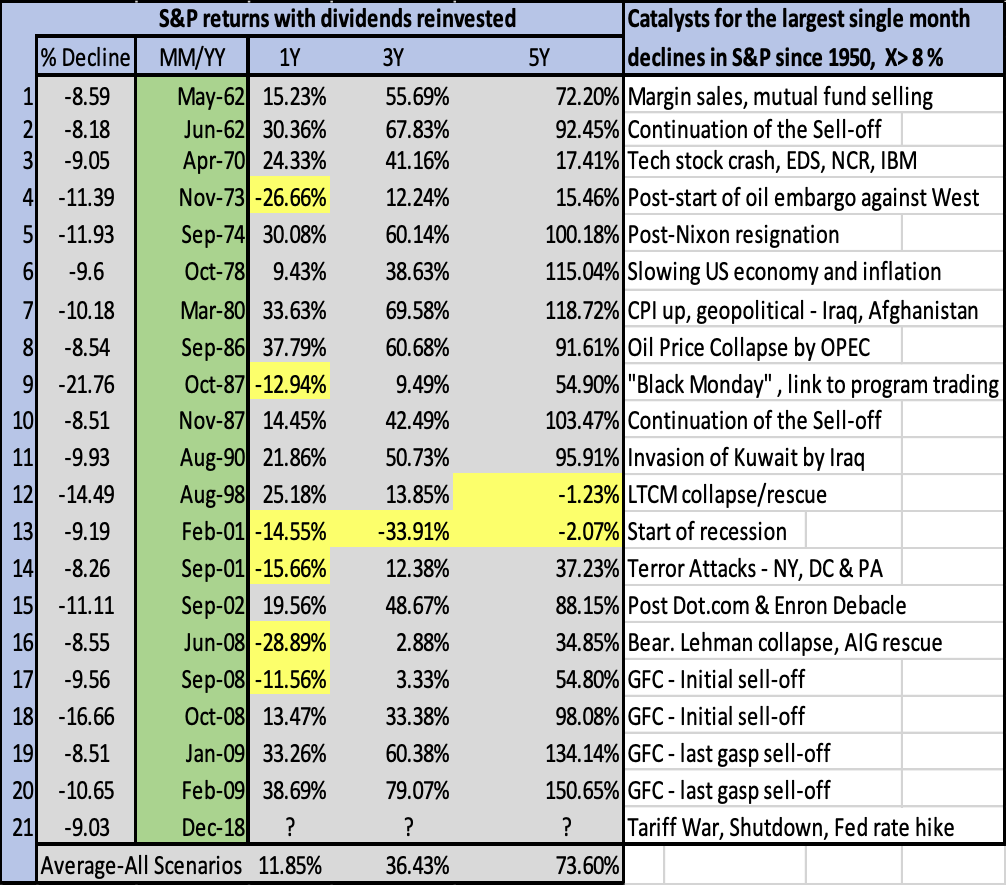
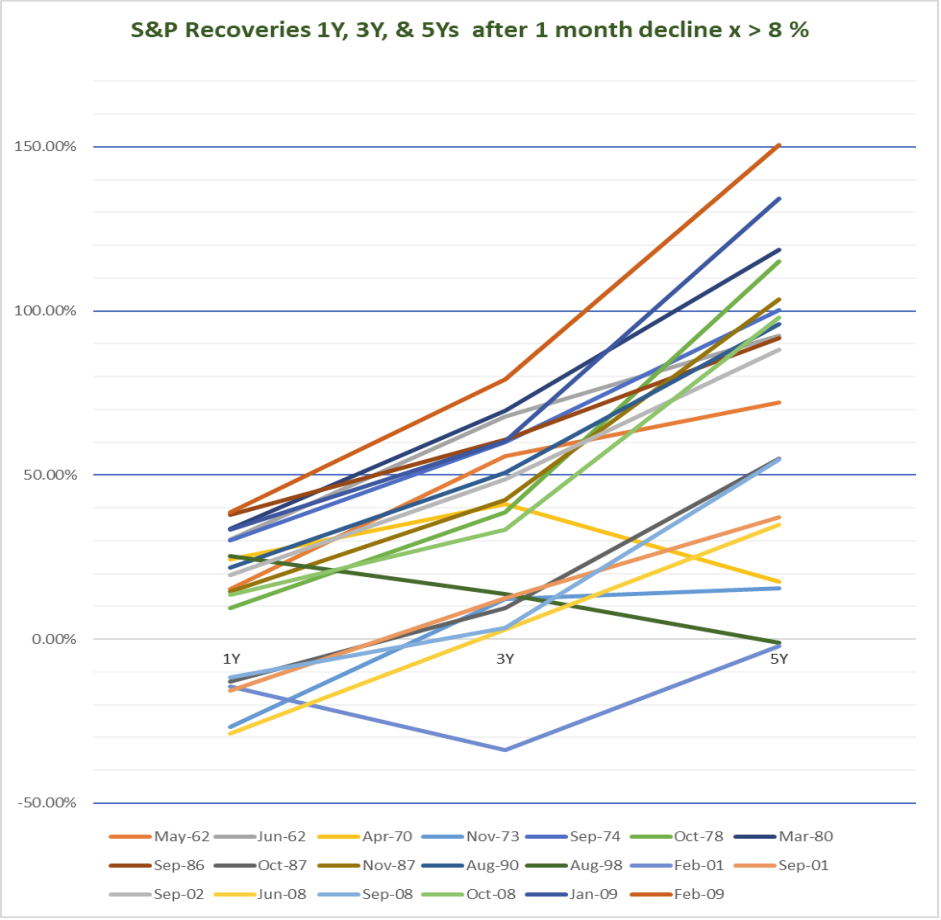
Largest One Month S&P Declines and Subsequent 1Y, 3Y, and 5Y Returns

Given the magnitude of the S&P Sell-off in December 2018 (-9.03 %), we thought it would be instructive to examine past events of a similar magnitude. We selected all single month sell-offs since January 1950. Here is a table and graph of our findings.

No one can predict what the future holds but certainly as one wag put it, “we’ve been to this picture show before.” Large drops in equity prices over a one month horizon are a temptation to take drastic action. Investors tend to become emotionally involved with the market and it is difficult to remain disciplined. What is critical is that investors build portfolios that are resilient to market corrections and achieve the best long-term risk adjusted returns. We present the historical data for the reader’s own interpretation.

Want to learn more? Please contact Chris Cutler, Tom Donahoe, or Safia Mehta at 917 287 9551.

Avoiding High Costs of Transitioning Assets to a new OCIO

A major utility company’s service promise is “We’re on it!” A new OCIO will say the same thing. In fact,
most OCIO’s have dedicated teams that arrange new client onboarding. From personal experience, the
process is problematic, and the transition tends to leave client’s money on the table. This could easily
cost the Foundation up to 1% or more in value of its corpus.

Here’s why – Once a client gives “walking papers” to the existing OCIO, it is essentially “pencils down.”
Cooperation often tends to decline; it’s just human nature. Likewise, a new OCIO may assert that they
do not own the performance until the assets hit the new custodian’s books at the new OCIO. This
potential material gap in performance is owned by the client. Here are typical stages in a transition and
miscommunication often leads to process delays.

Manager Analysis Services can help you avoid those costs by acting both as your search consultant
and as your transition consultant.

Documents Needed by New OCIO Team (partial listing)

-Articles of Incorporation, EIN Document, IRS Letter of Determination
-Bylaws, List of signatories, etc.
-Existing Investment Policy Statement and Asset Range Grid (both subject to editing by new OCIO)
-Board resolution confirming appointment of the new OCIO

Critical Handling of Your Assets

Which assets will be sold, when and how, and how will proceeds be transferred?
Which assets can be transferred electronically? (ACAT)
Which assets will follow over time? Proper timing sequence.
Transition Allocation: Will proceeds and assets be transferred over “as is” to the new OCIO? Will
there be a reallocation by asset class amidst the asset transfer process?

Special Instructions

Who are authorized signatories to transfer of proceeds or assets from old OCIO with new (i.e. nonstandard) wire instructions that the custodian will need to verbally confirm via call backs?
Depending on the sequence and settlement dates, will the Foundation be out of the market (wholly or
partially) for 1 or more days? Will the new allocation occur over time or be “averaged” into the market,
or fully deployed ASAP? (You should insist on a detailed transition plan and probe for gaps/errors.)

Reconciliation of all Transactions in Anticipation of EOY Audit Review

If you do not take steps to have all the transfers and liquidations, etc. reconciled within a few weeks
following the transfers, you are inviting future headaches, costly reconstruction of data, etc. Auditors
have a laser-like focus on these large transactions, given the absolute size relative to total assets, as well
as margin for significant error and losses.

Want to learn more? Please contact Chris Cutler, Tom Donahoe or Safia Mehta at 917 287 9551

Outsourced CIO or Not? How an IC Might Approach the Decision

Let’s explore how an Investment Committee may approach the decision in an organized process:

a) Your Range of Available Alternatives
b) Key questions to Consider
c) Obtaining Buy-in from Your Fellow Committee Members
d) Educating Yourself on the Advantages/Drawbacks
e) Ensuring a Focused Comparison of Providers
a) Your Range of Available Alternatives

The typical continuum of Investment Management approaches are as follows:

Certainly, there are variations of the above four approaches including a hybrid of approaches.
While each approach has the potential to succeed, there are approaches that contain inherent
structural and behavioral flaws which may impede success. (One could also split the portfolio
corpus between internal CIO and outsourced CIO management.)

In an AGB publications1, they “strongly advise against…the investment committee [that]
functions as CIO, often with the help of a consultant…we now have decades of strong evidence
that Investment Committees simply have found it difficult to succeed in this role2 .”
If we accept the results of the AGB research, then we are left to focus on Internal CIO, IC Chair
as CIO, and Outsourced CIO. Internal CIO (and staff) introduces the issues of cost, economies
of scale, and compensation/personnel issues. IC Chair as CIO concentrates power and discretion
in a single person, who is a volunteer. It may work if the person has the required expertise,
leadership experience, and the time to focus. Let’s now turn attention to the focus of this
briefing, how to consider an Outsourced CIO.

b) Key Questions to Consider

Let’s consider whether an Outsourced CIO may be appropriate for your organization. Before
considering the merits, some threshold questions are appropriate:

  1. A non-profit typically retains outside legal counsel, external auditor, IT expertise, payroll management, grant tracking, etc. (all non-core activities) where external expertise is needed and a recognized value-add. Do members of the IC view an Outsourced OCIO as a value-add and are they willing to give up day-to-day investment control and shift their focus to oversight and more strategic issues?
  2. If the Board is open to an Outside CIO, what are the existing and future challenges/issues that the committee is trying to address?
  3. What are the range and type of desired investment offerings that need to be provided by the Outside CIO?
  4. How should the Committee members educate themselves as to what’s available, what’s appropriate for their organization and how can they effectively and efficiently internalize the information to arrive at the best outcomes for their organization.

(Certainly, there are more detailed and other helpful questions that will assist a committee
in its analysis, but we shall consider only those above for purposes of our review here.)

c) Obtaining Buy-in from Your Fellow Committee Members

Research has shown that non-profits, with rare exceptions have simply not maintained the
purchasing power of their Investment Portfolios, especially relative to the pre-GFC (2007)
levels.3 In order to conduct an effective Outsourced CIO search, the IC members must first agree
that there is a challenge to be addressed. If there is disagreement on the IC as to which of the
four main approaches presented are appropriate, the search process may be fatally flawed and
simply not lead to the best outcome. It may well further divide the IC if the differences of
opinion are not subject to suasion or authentic consensus.

If authentic agreement can be reached to move forward, then the IC should be specific and agree
in writing, on the precise parameters of who should have what investment management
responsibilities and the proper assignment of oversight duties.

The IC should agree on what gaps or deficiencies are to be addressed. They should review their
existing IPS and see if it really addresses how they would like the portfolio to be managed on a
go forward basis. This is the time to identify asset classes, investment structures (e.g. comingled
accounts v. SMA’s) that the IC wishes to embrace or avoid. If there is a desire to focus more on
impact investing or ESG, this is the time to identify that as an item of inclusion, as well.

d) Educating Yourself and IC on Advantages/Drawbacks of an Outsourced CIO

An Outsourced OCIO is no panacea but a means to an end. Given the customized demands of
individual non-profits, you need to understand what your wants are and what is available or
customizable in the market. There is abundant information available on provider websites and
some can be quite useful, and while much may not be directly on point for your needs. You
could invite a sample of providers to address your IC at periodic meetings and gradually obtain
key points of information, but the information may be skewed or incomplete.

In the alternative, it may be more cost effective and time efficient to hire a search consultant who
can match your specific needs to what the outsourced CIO providers offer and what could be
created for you. Be mindful that there are 80+ OCIO providers who assert national coverage and
yet they have quite different investment approaches, investment vehicles, asset class coverages,
reporting capabilities, fee structures, gradations of outsourcing services provided, etc.

You also need to achieve a “good fit” with your ultimate provider. This will maximize your
chances of forming a long and worthwhile partnership with your provider. A search provider can
provide a team who gets to know you and can partner with you to achieve your specific goals.
The team will be your strongest advocate throughout the search and the on-boarding process.

e) Ensuring a Focused Comparison of Providers

Although the industry has grown to $1.1Trln4 over the last 20 years, it suffers from a lack of standardization in reporting returns and some opaqueness as to total fees charged. There are a variety of OCIO firms each with their own areas of strength. The lineup of providers includes a) the largest OCIOs with +$90 Bn in AUM, b) medium-sized OCIOs who are considered the $15 – $30 Bn range, c) niche OCIOs who have a specific investment strategy focus, and 4) alternatives-focused OCIOs. If the Committee does not have a consensus view as to the type of OCIO they would like to work with, seeing a variety of OCIO models and reviewing the services obtainable from each would help the IC arrive at a more informed decision.

An additional caution is that once an Outsourced CIO is chosen, then portfolio assets will likely
need to be liquidated and/or transferred to new custodians. There are risks involved with this
timing and asset transfer. It should be planned in specific detail to ensure that there is no market
timing or excess bid/offer spreads incurred. Without enough planning and oversight, losing 30 –
80 bp’s on the portion of the portfolio liquidated can occur. There could also be legacy assets.

Summary

In summary, the goal is to ensure the IC fully describes what its needs are and what level of
discretion suits its members. If there is not agreement by the IC members PRIOR to the actual
search, it will be likely be more difficult to achieve the best outcome possible for a non-profit
organization. There are a broad variety of providers whose specific expertise and structure
enables them to provide solutions best suited to some types of clients rather than others.

Want to learn more? Please contact Chris Cutler, Tom Donahoe or Safia Mehta at 917 287 9551.

1 Association of Governing Bodies of Universities and Colleges, “Endowment Management for Higher Education”, 2017, AGB Press, Washington, D.C.

2 They cite 4 impediments: Lack of expertise, difficulty in making timely decisions, inability to make difficult, contrarian decisions, and diffusion of responsibility., ibid., p.25

3 Sandeep Dahiya, David Yermack. “Investment Returns and Distribution Policies of Non-Profit Endowment Funds.” Report 11/27/2018 Available on https://papers.ssrn.com

4 Cerulli Associates/Blackrock, “OCIO at an Inflection Point”, P. 3, Report 2019 © 2019 MAS, LLC

Don’t Be Shy! Non-Investment Services an OCIO Can Offer You.

Governance Policies

  1. Periodic, formalized review of Investment Policy Statement (including ESG Investing)
  2. Addressing governance issues and increase efficiency of your Board or Committee
  3. Guidance as to evolving worlds of ESG and Impact Investing
  4. Recommendations as how to overcome any Board dysfunction
  5. Be a neutral “sounding board” for doing things differently or changing processes

Reporting

  1. Providing ad-hoc investment reporting
  2. If some investments are held elsewhere (not with the OCIO, e.g. legacy assets), OCIO may be able/willing to include those positions with OCIO-managed assets and present holistic portfolio summary
  3. Accommodate your special file format needs, e.g. CSV or uploads to secure website
  4. Access to OCIO’s risk portal if it is offered to clients

Accounting/Audit

  1. Provide guidance on special treatment needed for bespoke assets or alternatives held
  2. Help with Audit/IRS requests re: valuation or investment reporting
  3. Assistance if there are concerns about K-1 information/accuracy

Peer Networking

  1. Provide a sense of how peers approach a common issue or provide actual introductions
  2. Obtain information as to salary scales, job duties, size of specific departments, etc.
  3. Invitations to annual/OCIO investor events or industry seminars that may be of interest
  4. Provide research/book/website recommendations

Fund Raising

  1. Introduction to like-minded charities or orgs willing to make grants to the same causes
  2. Meet your donors to assure them that the corpus monies are being prudently invested
  3. Provide future projections of returns and budgets to provide support for a capital campaign

Evaluating/Selling Exotic Gifts Received

  1. Real estate gifts provide a challenge/interim liability between obtaining title and closing a sale
  2. More exotic asset classes such as cryptocurrency create special challenges to liquidate
  3. Art and Sculpture may require special insurance while an exit strategy is planned/effected

Hiring/Vendors

  1. If you wish to get recommendations for an open staff position at your organization
  2. Vendor recommendations (Outside Counsel, IT Security, Grant software, etc.)

The range of ancillary services varies widely across OCIO managers. The ManagerAnalysis.com
team can help you achieve the best match from available OCIO providers to achieve your
specific needs.

Want to learn more?

Please contact Chris Cutler, Tom Donahoe, or Safia Mehta, at 917 287 9551 or 973 452 3992.

©2019 MAS, LLC

Building your in-house Investment Office? What would it cost?

Endowments and Foundations continue to wrestle with determining the best way to manage their portfolios:

  • Build an in-house team?
  • Hire an Outsourced CIO team?
  • Or engage a Consultant Advisor?

Since most Endowments and Foundations (“E&F”) depend heavily on the success of their investment programs, solving this challenge is a key determinant of their ultimate success.

Our research goal was to observe how E&F offices are making this determination, based on their portfolio sizes and number of staff. We focused on the empirical data available for 35 Endowments and Foundations of various sizes. We used E&F’s that had the most verifiable information available in the public domain, reviewing their tax filings, public websites, and LinkedIn profiles to obtain the required information. The data is intended to answer the following four questions:

Key Questions Addressed

  1. If you are planning in-house investment management, how do your staffing decisions compare with what others are doing currently?
  2. What does an In-House Investment Office cost?
  3. Is there a typical AUM transition point where E&F’s might transition between In-House or OCIO Investment team approach?
  4. What are the specific staff roles and org chart characteristics for an In-House Investment Office?

What we learned was both expected and unexpected. Managing an “Endowment Style” Investment Office means managing a complex, private portfolio and a multitude of managers. Yet, the In-House Investment Office size appears to have a definite ceiling.

While the specific facts and circumstances of each E&F investment corpus and each non-profit’s internal structure or requirements are not publicly available, there is detailed information available on key aspects of E&F’s portfolio management. Specifically, we were able to obtain the actual headcounts and the total compensation of the most senior members of each investment team. This is not a scientific sampling, rather it is hard data from a cross section of AUM sizes from $50 mm to $12 Bn. Using this data, the reader will obtain additional perspective as they determine whether building internally or embracing the Outsourced CIO model is the best fit for their organization.

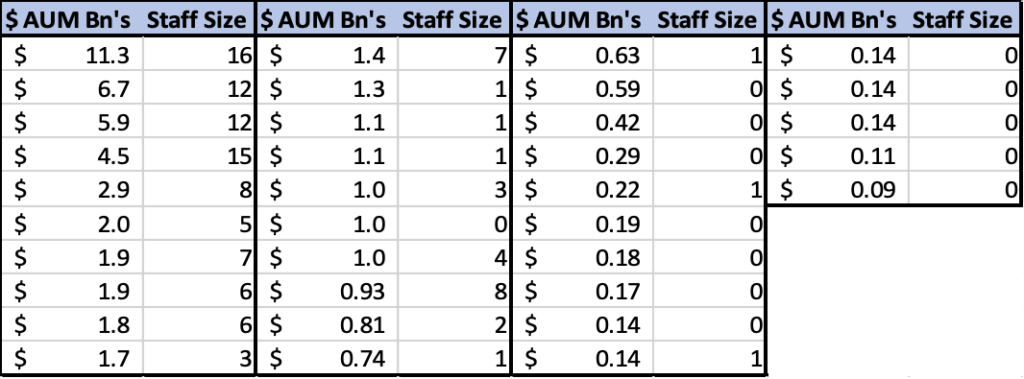
The information on each of the 35 organizations is arranged from largest AUM to smallest AUM. Here are our general observations.

Main Conclusions from the Research

In-House Investment Office

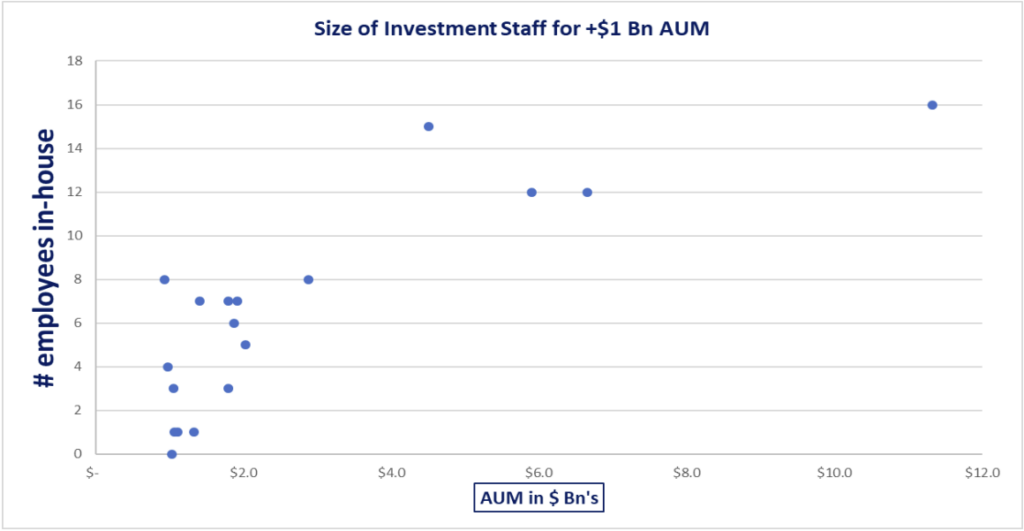
  • >$4Bn AUM generally have in-house investment staffs of 12-16 professionals.
  • $1 Bn to $2 Bn generally have in-house investment staffs of 4-6 professionals.
  • $500 mm to $1 Bn opt for either in-house management or Outsourced CIO.
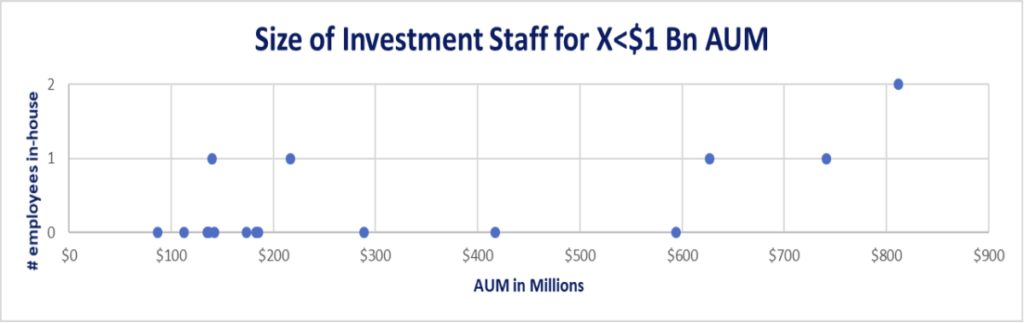
  • $50 mm to $500 mm often have a single in-house professional or rely on an Investment Committee with/without assistance of a consultant. The sole in-house professional may be more of a liaison and may be focused more on development efforts. (Nearly half of this sized cohort have adopted the OCIO model per industry research.)

There appears to be a tug of war as to whether in-house or OCIO works best in the $750 mm to $1 Bn AUM range. We have seen non-profits grow past the $500 mm AUM and decide that they are large enough to build an in-house team. There have been some notable exceptions recently with some names just below the $1 Bn AUM level. Several have decided to scrap the in-house Investment Office model completely and embrace the OCIO model.

The total team compensation appears to be as follows, based on $AUM size:

  • Mega +$4 Bn AUM – $5 mm to $7.2 mm range
  • Large $2 Bn AUM – $2 mm to $3.5 mm range
  • Medium $1 Bn – $2 Bn AUM – $2 mm to $3 mm range
  • Small x<$500 mm AUM – $300 k-$400 k range

Our total compensation aggregate estimates rely on actual published total compensation numbers for typically the CIO and the next management level, e.g. Director of Public Markets, Director of Private Markets, MD’s, or Sr. Portfolio Managers. The compensation levels for analyst/operations level staff are estimated based on the specific titling/job description obtained. We omit all investment related costs, e.g. Bloomberg terminals, technology costs, office rent, custodial fees, due diligence travel/research, etc. since they vary widely depending on investment strategies. Moreover, the sum of all external investment consultants together can cost well over $1 mm p.a., especially for larger portfolios. Thus, these additional expenses are not immaterial.

Organization of the Remainder of the Briefing

  • Two scatter plots present a comparison of in-house staff v. $AUM. +$1 Bn and X<$1 Bn)
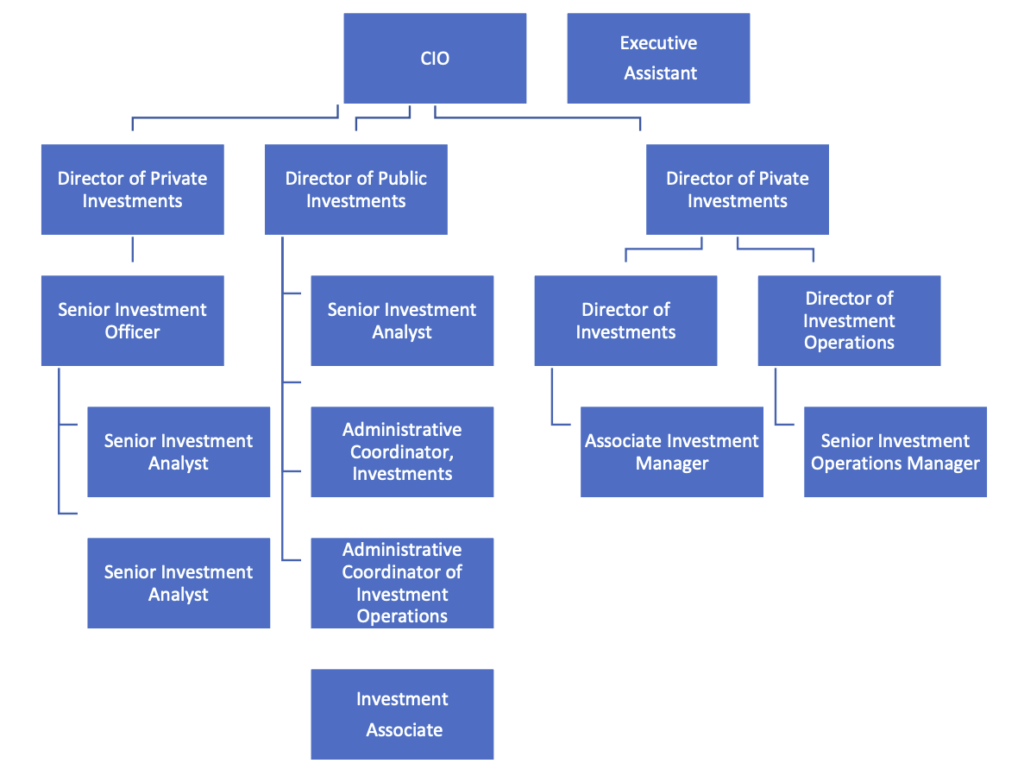
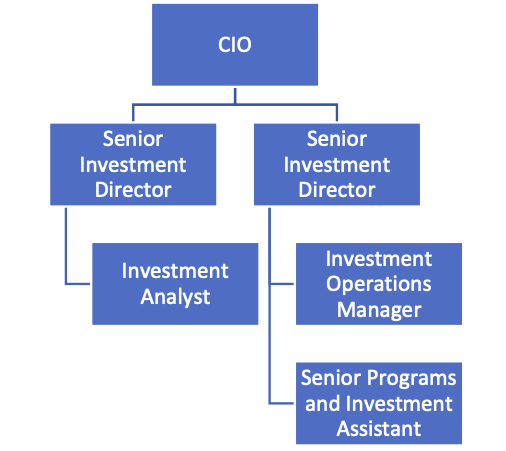
  • Organization Chart for a large >$10 Bn AUM team • Organization Chart for a $1 Bn to $2 Bn AUM team
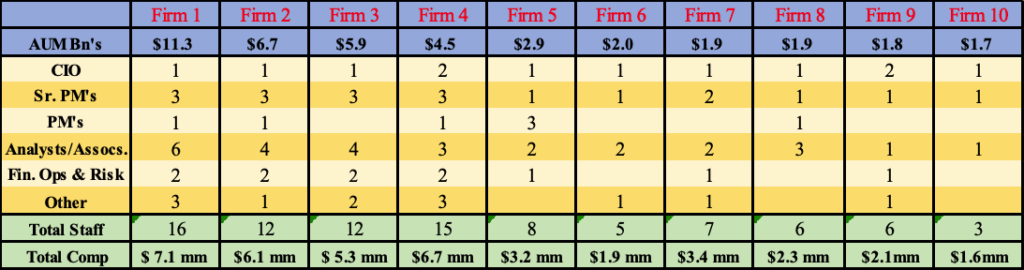
  • Appendix that lists 10 large E&F’s and provides $ AUM, Staff size, positions by job titles, and total team compensation for the Investment Office.

Ratio of In-House Staffing Relative to Size of Endowment/Corpus

The scatterplot below for 18 Non-Profits demonstrates two staffing clusters. $4 Bn+ AUM leads to in-house staffing of 10 -16 investment professionals and support staff. $1 Bn to $4 Bn AUM leads often to in-house staffing of 4-8 Investment professionals. The staff figures are almost exclusively investment professionals but there are some admin or shared resources as well.

The scatterplot below for 17 Smaller Non-Profits demonstrates skeletal investment staffing:
Less than $1 Bn AUM leads to in-house staffing of 0-2 investment professionals and support staff.
Nearly half of the “0” in-house investment professionals reflects the adoption of either an OCIO
or Consultant Advisory model. What is striking is that there are two E and F’s in the $650-$750
mm AUM range that are a one-person “team.”

Sample Org Chart for approx. $11 Bn AUM

Sample Org Chart for $1.5 – $2 Bn AUM

Summary Table of all 35 E + F’s by AUM and In-House Staff Size

APPENDIX

The goal of this appendix is to provide the reader with the staffing (by category) for 10 large
Endowments or Foundations. The entities are ordered in descending $AUM size. All these E&F’s
have built and maintained in-house Investment Offices.
N.B. 2 entities (in the $750 mm – $1 Bn AUM range) opted recently to convert from in-house
Investment Office to adopt the OCIO model. This range appears to be the inflection point where
Boards/Committees struggle to decide what structure suits their organization best.
The total compensation by team is included as well. Do note that under the Other category, it
covers administrative roles that are not strictly investment-trained positions. Since they are
included on the public websites of these E&F’s as being members of the “Investment Office”, we
have opted to embrace this self-identification by the E&F’s.

Want to learn more? Please contact Chris Cutler, Tom Donahoe or Safia Mehta at 917 287 9551.

© 2019 MAS, LLC

TRANSITION TRAUMA – How To Avoid Losing Up To 1% of Your Portfolio

Virtually every large Outsourced CIO boasts a “dedicated onboarding” team. You will hear pleasant words like “seamless” and “facilitate” and “full transition takes 5 to 10 days.” This all
sounds so reassuring. As a Fiduciary, you can simply not rely on those “happy noises.”

Perhaps it is the number of moving parts, the reliance on a skeletal checklist, or the failure to
perform a simple “walk through” exercise that is the biggest culprit. When legal, operational or
IT roadblocks are not uncovered until the transition is underway, the likely result is economic
damage to your investment corpus.

A sample portfolio to transition might be:

  • 40% public equity securities
  • 20% fixed income securities
  • 15% Hedge Funds
  • 10% Private Equity
  • 5% Real Estate
  • 10% Cash

The simplistic view is hold onto to the cash, sell the liquid securities, and do the best you can
with the alternatives holdings. That approach glosses over some critical decision points:

  1. Proper sequencing of asset sales by asset class, date, and time.
  2. Not coordinating the timing of sales/buys to be synced to intraday/market close.
  3. Not factoring in the different settlement dates that vary by instrument and fund, e.g. mutual funds v. ETF’s v. security assets.
  4. Whether borrowing to facilitate the purchase of replacement assets is allowable.
  5. Whether futures/ETF’s could maintain needed market exposure and minimize the impact of settlement mismatches.
  6. Failure to minimize “time out of market” if that is your goal.
  7. No agreed timetable to perform a reconciliation or what constitutes “full” reconciliation.
  8. Decision to change asset allocations amidst the transition process itself.
  9. No clear game plan as to “care and feeding” of legacy assets.

Public Equities might be individual securities or held within mutual funds or ETF (Exchange
Traded Funds.) Each asset has its own settlement date as well as exit process. This means sales
timing issues and settlement issues. Public Equities may be sold intra-day (or MOC-market on
close, or VWAP-volume weighted average price.) Mutual funds pricing is at end of day, ETF’s
can be intraday or MOC and when you receive sales proceeds varies by instrument.

Hedge Funds are often liquidated only on a quarterly basis and there are typically holdbacks.
There may be investor-level or fund-level gates as well.

Private Equity has almost no liquidity and you may need to sell on a discounted basis in the
secondary market if you cannot wait the additional year(s) likely to full redemption. Legacy
assets require dedicated management and oversight.

When you change custodians, your existing custodian likely must follow up with phone calls
backs to authorized signatories. The signatories (Trustees) have busy lives and this further
restricts your flexibility to sell and buy at the best times to ensure a smooth transition. Beware
the vague or incomplete timetables or assurances that “we’ve been doing this a long time.” You
should require a daily update as to sales/proceeds and when/where these proceeds will be sent.

As part of our Outsourced CIO search services, we are also available to oversee the transition
process to ensure that your institution does not have gaps or additional market exposure during
the Outsourced CIO transition.

Want to learn more?

Please contact Chris Cutler, Tom Donahoe, or Safia Mehta, at 917 287 9551

©2019 MAS, LLC