October 1, 2026
Much has been said about disappointing PE fund returns when compared to public market returns over the last four years. We have seen a real slowdown in PE returns, especially versus the S&P 500, and a prolonged slowing of PE Funds’ capital distribution rates adds questions about whether PE carrying values are actually accurate.
Investor belief in the sustainability of their PE programs often seems to rely on the longevity of their experience. As you can see from the graphs below, investors with over 20 years’ PE allocation experience remember the great performance of PE compared to public equities. From end-2004 to end 2014, the return of the average PE investment, as measured by Cambridge Associates, was about 260%, compared to the index performance of both the S&P 500 and the Russell 2000 of only about 110%. However, from end-2020 to end-2025, the S&P 500 returned about 96%, while the PE average returned only 63%. Small cap equities performance was meager, up only 33%.
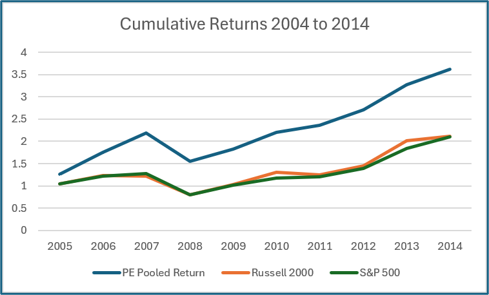
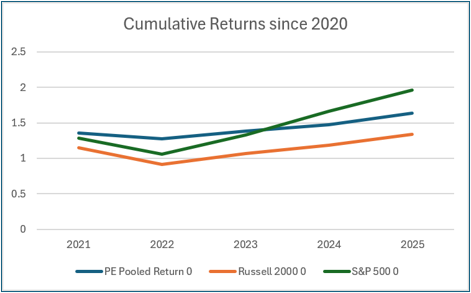
Is the relatively new weakness in PE returns a temporary deviation or indicative of a long-term pattern? Does the long-term investment thesis of PE managers still hold, that an abundance of small companies could benefit from the resources brought to them by PE firms? Is the potential to create value from having a private equity manager to manage a company both professionally and privately is compelling?
Checking assumptions
As an Economist by training, I like to look further for indicators of economic drivers. We understand that higher interest rates have hurt PE investments because PE managers face higher financing costs over the last four years. We also understand that PE funds have tended to invest in sectors that have not kept pace with the broader market, like potentially legacy SAAS businesses, and away from cloud computing or AI businesses.
But the central question is whether PE managers can still see promising opportunity sets for future investments. If there are great, untapped opportunities, then PE investing could look very favorable and investors should sustain their allocation programs. Conversely, if there are limited opportunities available, would it still be reasonable to expect PE managers to outperform public equities?
The private investments industry has an obsession with analyzing returns. Looking through the Q1 2026 Cambridge Associates Private Equity Index and Benchmark Statistics Report, I see a wonderfully detailed compilation of carefully calculated statistics by a truly dedicated leader in private investing. What is missing in this excellent 112-page report? The most obvious statistics: the “total allocation” of assets invested and outstanding each time period. Not to single out Cambridge, since Pitchbook and Preqin reports also seem to miss highlighting this data as well, though I’m sure all three data providers have compiled that data.
Let’s look at quantities invested in PE, thinking about an analogy to fishing boats. If there are very few fishing boats in a bay, they can pick the best fishing grounds with ample catches. Conversely, if there are many fishing boats, they may face waters crowded with other boats and see much smaller catches. So where do PE managers compare to these fishing boats? Are they facing an abundance of opportunities? Or is their market crowded with competitors and diminished catches? One indicator would be the ratio of PE funds under management [number of fishers] to the overall small cap equity market [as a proxy for volume of fish to catch].
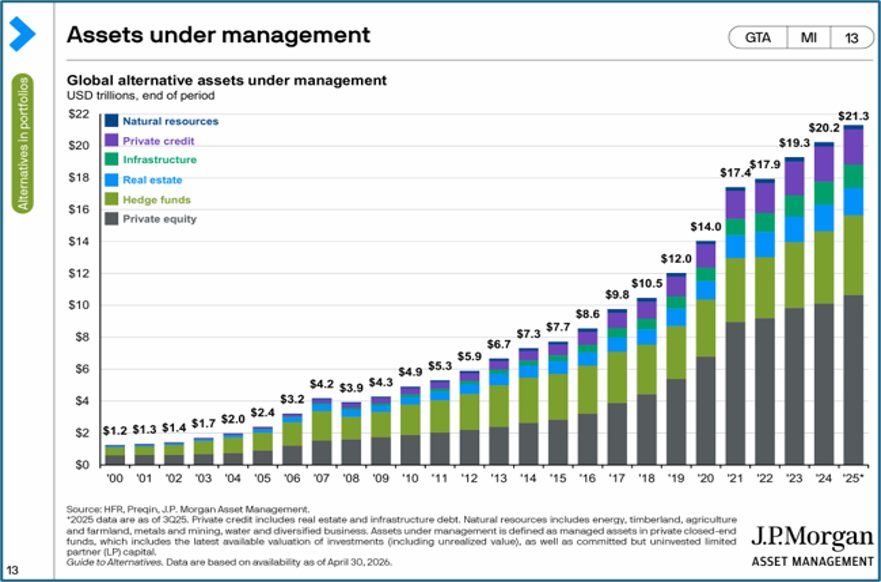
J.P. Morgan Asset Management’s Q2 2026 Guide to Alternatives (See CHART I on the last page) estimates that PE represented about $10.5 trillion globally at year-end 2025, up from about $9 trillion at the end of 2021, $5.5 trillion in 2019, under $3 trillion in 2015, and $2 trillion in 2010, and under $1 trillion in 2005. Let’s compare those figures to the size of the Russell 2000 market over time:
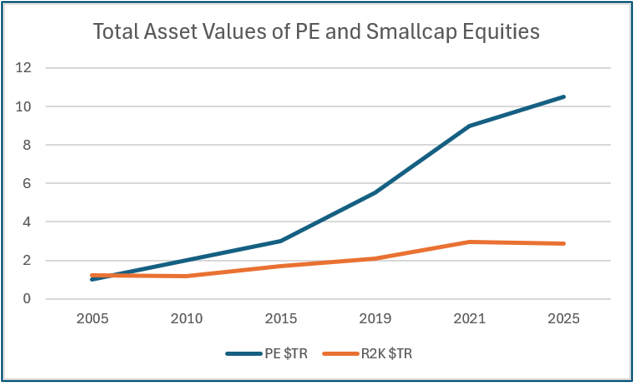
The relationship between private equity markets and small cap equities has clearly evolved. First, we see PE investments stifling the growth of small cap equities, acting as a substitute source of capital. Our prior research on small and microcap public companies indicated that regulatory costs could consume over 5% per annum of ROE for smaller companies, so there is a direct economic advantage to being privately held if a firm is small enough.
Second, if private equity managers were looking to small cap equity companies or IPOs as a source of exits, that has clearly become more difficult to expect, with the small cap market at only 30% of your market’s size. Conversely, if you can accept the size of the small cap market as a proxy for your opportunity set for buying new companies into your portfolio, it is clear that you are facing over harvested fishing grounds.
The comparison I selected is very simplistic. PE firms are mostly buying private companies, not so much taking small cap companies private. Nonetheless, the size of the market of private companies not already invested in by private equity funds I would argue has become much smaller, though I do not have data on the remaining ex-PE private company market. Another simplification is that I used the global PE market size, of which about 1/3rd is ex-U.S., so the graph above mildly overstates the problem. Even so, I think the comparison indicates that PE firms are more likely to struggle to find exits, since the pool of potential buyers from publicly listed companies interested in their businesses is greatly depleted. Sales to other private equity managers, secondary funds, or other means that lack the pricing transparency of public markets will rise in importance, but these methods do not match the historic expectations of institutional investors for transparent exit means.
Conclusions
PE investments have historically provided attractive returns, but a crowded market with diminished investment exit routes might bring an end to the “era of alpha” from the “asset class” of PE. We believe that PE brings diversification benefits and opportunities for excellent returns, but should be looked at more from the perspective of a sector-driven lens than in the past.
Some OCIOs could be missing some of the best opportunities by focusing on very large managers and avoiding the below-$1 billion private equity managers. OCIOs should concentrate on their better PE managers, and have a clear investment thesis. They should also be careful of additional work that arises from the growing use of continuation vehicles, which require diligent OCIOs to understand underlying portfolio companies, not just the PE manager. Continuation vehicles also call for OCIOs to be ready with an investment thesis on each underlying portfolio holding, so they can decide whether to take the liquidity or roll their investment over into the new continuation vehicle.
Thus, we see a continuing role for PE investments in institutional portfolios. However, having such investments is becoming more of an ancillary addition than a core allocation necessity for sophisticated institutional investors. Moreover, the effort involved in allocating to private investments is increasing, as OCIO analysts must now cover underlying investments in their PE funds, so they can be ready to decide quickly whether to participate in secondary sales and continuation vehicles. These difficulties could lead to OCIOs gradually reducing the amounts they commit to PE funds.
In conclusion, we are seeing a changing role for PE at OCIOs. Prioritizing private equity investments was seen as a top priority as recently as four years ago. The discussion is more nuanced today. We see some OCIOs actually pulling back on their PE recommendations as public equities have mostly outperformed private equities, while others sustain their commitment to the PE “asset class,” and expect both returns and distribution rates to recover to their long-term profile of outperformance. Many OCIOs are also enjoying a resurgence in alpha creation from their hedge fund managers, while seeking other ways to product alpha beyond private equity markets, so their reliance on PE investments has somewhat diminished.
We view 2025 and 2026 as an inflection point for Private Equity at OCIOs, moving away from a solid growth trajectory. We see the potential for a meaningful long-term decline in traditional private equity investments at OCIOs, but we also see private equity remaining a core piece of many OCIOs’ model portfolios.
Chris Cutler CFA
President
Manager Analysis Services, LLC
CHART I