Hedge Outfits Partner to Launch Quant MultiManager Platform

By Lydia Tomkiw March 4, 2020

“There is a need for more capacity in the space, especially with many quant funds closed and a desire for strategies that produce uncorrelated alpha,” says Chris Cutler, president of Manager Analysis Services.

“I think [Investcorp and HC Technologies] are smart to try,” he says. “If they can attract enough talent and resources, they will probably succeed in the long run.”

Is That Hedge Fund Safe?

By Mark Myers

Hedge funds are supposed to protect your investment portfolio against the risk of market downturns. But given the secretive nature of these lightly regulated private investment partnerships and the recent spate of hedge-fund failures, your biggest risk may actually be the hedge fund managers themselves.

Consider this: About one in three new hedge funds are likely to go belly up within three years of opening for business because their managers lack the skills and stamina necessary to attract and manage assets. Even seasoned hedge-fund managers can jeopardize shareholder assets by cutting corners or going too far out on a limb to achieve and sustain higher returns. And then there’s Bayou Management and Wood River Capital Management, whose fund managers were recently accused by the government of fraud and misleading investors.

To avoid being burned, more individual investors are hiring special hedge-fund investigators to verify and monitor the backgrounds, skills, and performance of hedge-fund managers.

Skeletons in the closet

Most affluent investors choose hedge funds based on the say-so of wealth advisors, colleagues or friends. But such recommendations can be dangerous since most of these fund advocates have conflicts of interest and the field is largely unregulated by government agencies. Some investors try to research hedge funds on their own, but most lack the forensic training to drill down far enough or identify the biggest problems.

Hiring a team of hedge-fund investigators can make this task easier and more productive. An investigative team is usually made up of a fraud investigator who performs in-depth background checks, a manager analyst who assesses the outlook for the hedge fund’s strategy, a lawyer who specializes in hedge-fund offering documents, and an accountant who has conducted hedge-fund audits.

The fee for a team investigation is relatively low, ranging from $5,000 to $10,000,
depending on the assignment. Results are commonly available within weeks, and many investors retain investigators to monitor their hedge funds on an ongoing basis.

Skills that fall short

In addition to personal background checks, investigators evaluate the skill sets of hedge-fund managers. “Clients need to know whether a manager is professionally qualified to handle the sophisticated strategies promoted in the marketing materials,” says Chris Cutler, president of Manager Analysis Services, a New York firm that evaluates manager abilities and fund operations.

Last year 35% of the funds that MAS investigated were run by managers who lacked sufficient training for the investment strategies they were using. Other funds scored low operational marks for charging excessive fees, imposing unfavorable lockup provisions, and failing to cooperate with MAS on valuation issues. Of the funds reviewed, 15% ranked as strong investment candidates.

To assess a hedge fund’s operations, MAS looks at its trading strategy, how much risk the manager assumes to achieve returns, and key aspects of the fund’s infrastructure. These factors include the quality of third-party valuations, audited fund statements, and whether administrators check to see that all expenses paid are permitted, and that there are no hidden fees within the fund structure.

(Redacted)

Forbes | Suit Says UBS Feeder Funds Knew Madoff Was Fishy Back In 2006

By Robert Lenzner

In 2006, the UBS feeder funds to Madoff hired consultant Chris Cutler [President, Manager Analysis Services] to do probably what was the first due diligence on Madoff’s operation since 1985, when the feeder funds first invested with Madoff. It took Cutler only four days to discover the smoking gun: the options volume that Madoff reported as executed by the feeder funds exceeded by far the total volume of puts and calls actually traded in those securities on the Chicago Board of Options Exchange.

In other words, these put and call executions could never have happened. There was not enough volume of trading to have fulfilled orders just from these two accounts – not to speak of all the other Madoff directed investment accounts.

…All of these revelations are included in the complaint filed last week in U.S. Bankruptcy Court by the Securities Investor Protection Corporation and its appointed trustee, Irving Picard of the law firm Baker and Hostetler, against Bernard L. Madoff Investment Securities LLC.

(Redacted)

Services for High Net Worth Investors and Family Offices

Case Study B Longstanding Brokerage Links

Situation

  • A family office came to Manager Analysis via a referral from a Family Office that we assist. The family leader had managed wealth carefully, and he benefited from the stock market’s long-term performance. However, because he had kept portfolio management considerations away from his children, and because the entire family wanted to plan for an orderly transition of responsibilities, the family asked Manager Analysis to review the family’s portfolios and identify any material threats to the assets.
  • The next generation was generally pleased with their current holdings, comprised primarily of liquid, larger cap equities, and muni bonds, and they did not want to alter the strategy. They also valued their operationally conservative profile and comparably simple legal structures. Virtually all of the assets were held directly and so the family was in a good position to control the timing of transactions to avoid unnecessary capital gains taxes.

Findings

  • The broker was attempting to gain discretionary control of the family’s portfolio through sleight of hand.
  • Buried within a simple “principal transactions agreement” was a commitment for the family to a second agreement, granting the broker full discretion. The family did not to sign the form because of our strongly delivered advice.
  • While portfolio turnover was low, the broker was charging commissions of 1% to 2% on large stock trades. He was seeking the opportunity to liquidate the entire estate’s liquid holdings to receive a $1 million commission. Comparable commissions would be about $125,000.
  • We also conducted reputational reference checks on the broker and found that he had been placing clients into the highest commission investment products permitted by his brokerage firm.

Resolution

  • We assisted the family in establishing accounts at other brokerage firms, who charge zero or near-zero commissions on equity trades, and we are currently in the process of moving their holdings.

Want to learn more? Please contact Chris Cutler, Tom Donahoe or Safia Mehta at 917 287 9551.

© 2019 MAS, LLC

Considering an OCIO (Outsourced CIO) search? You should lead with an RFI as a critical first step…

Its purpose is to have your most critical questions addressed upfront and quickly. You can then do a “deep dive” via RFP to those providers most aligned with your needs and your mission.

Difference between an RFI (RFI = Request for Information) and a RFP (Request for Proposal)?

Your RFI is composed of your own brief set of questions. The answers you obtain will enable you to filter the available provider set. You can then focus on those firms who can add the most value for you and your organization.

The advantages for you using an RFI :

  1. TIME SAVING – Your time is valuable and an RFI is the best use of your scarce time.
  2. REVIEW A LARGER POTENTIAL UNIVERSE OF PROVIDERS – Enables you to “ping” a broader range of potential providers so that the filtered group will be the most relevant of possible OCIO providers.
  3. CLARIFIES YOUR GOALS – As you compose the 5 to 8 questions, you focus on what your key concerns or needs are. This provide the opportunity for the Investment Committee to memorialize its specific goals. This will also help align the staff’s efforts.
  4. IDENTIFIES CONFLICTS OR HIDDEN ISSUES – An RFI surfaces issues early in the process so that you, and potential providers, don’t waste efforts or incur disappointments.
  5. FAIRNESS – Each bespoke RFP requires 60 – 80 hours of preparation. By contrast, an RFI should require no more than 3-4 hours of dedicated focus by each provider. The answers are best discussed via a conference call. A call could well elicit candid responses and be a “dry run” for how you might interact with each provider’s team.

Two Sample Questions for a RFI (typically one would have 5 – 8 questions):

  1. What are the key distinguishing features of your investment process that sets you apart?
  2. Are investment offerings done in form of comingled accounts, SMA’s. or other structures? What are the liquidity provisions of lock-ups/redemptions especially as they relate to Alternatives?

Want to learn more? Please contact Chris Cutler or Tom Donahoe.

How an OCIO Might Evaluate Your Existing Portfolio

Please find enclosed a sampling of two different approaches (among others) current in the market.

One OCIO may separate the evaluation between its Investment team and its Risk team. They “snapshot” your current portfolio composition and compare it to their own proprietary allocation.

  1. DOCUMENT REVIEW – There is a review of your Investment Policy Statement (Objective(s), Goals, Asset Allocation Targets, etc.)
  2. CURRENT HOLDINGS PROJECTED BACKWARDS – They “snapshot” the current holdings and model them back for 3 years and create a 1-year and 3-year performance profile.
  3. EQUITY COMPOSITION – They back-test to relevant industry benchmarks: geography and sector, market cap, style. In other words, they evaluate through the lens of key factor analysis.
  4. RETURNS v. FACTORS – They evaluate the passive and active portions compared to reference indices and determine what is the percentage of active share management (i.e. the profile that veers from being purely passive or “index hugging.”) They measure returns, R2 , alpha measurements, and beta values.
  5. RISK PERFORMANCE – The risk team focuses on the volatility measures and tries to determine the potential drawdown risk. They also try to determine whether the portfolio is currently built for through-a-full-economic-cycle holding period.
  6. FIXED INCOME ANALYSIS – Fixed income is compared to relevant FI benchmarks, e.g. Barclays Global Aggregate. They also measure the US Treasury composition, corporate debt, other categories, as well as the maturity buckets, interest rate duration, and credit rating duration.
  7. SUMMARY OF OBSERVATIONS – They then provide a summary of observations.
  8. RECOMMENDED ACTIONS – Are informed by a thorough 4 to 5-page analysis.

Another OCIO might perform an evaluation as follows:

  1. HOLDINGS PROJECTED BACKWARDS – They create a look-alike portfolio of your actual holdings. They assume monthly rebalancing and do a 30-year lookback, showing semiannual returns. They benchmark to a balanced long-term portfolio, a) US equity bias and 2) ACWI focused. They track return performance over time against purchasing power goals.
  2. INCREMENTAL RISK v. VOLATILITY OF RETURNS – This is a graphic representation of a NACUBO-cohort median portfolio adjusted for your organization’s size as well as a cohort of the OCIO’s own clients, also adjusted for size.
  3. TABLE OF ASSET CLASS ALLOCATION – They provide an asset class allocation grid which identifies 3 main categories (with sub-categories):
    • (a) Global Equity (US/Intl-EM), Alternatives (PE/HF/Comm./RE) and Fixed Income (Core/Opportunistic/TIPS/Cash.) They provide 4 additional columns;
    • (b) Policy Goal percentages by both categories and sub-categories), Min-Max range per the 3 major categories of assets,
    • (c) detailed Active Target (current),
    • (d) your own organization’s current allocations, and
    • (e) planned goals to reach over the next 6 mos. to 12 mos. Horizon. They are especially mindful of harvesting the illiquidity of alts as well as the volatility dampening nature of hedge fund holdings for a through the cycle resiliency of the portfolio.
  4. RISK ANALYSIS – They perform a thorough returns-based style analysis as well as a holdingsbased style analysis. They are especially mindful that using multiple managers sometimes obscures the combined risks if the portfolio information is not timely, consistent, and properly aggregated.
  5. “ACTIVE RISK” ANALYSIS – This is the risk segment of an investment portfolio that results due to active management decisions made by portfolio managers. This measure will also capture the impact of “market timing” decisions made by the managers. So, the active risk is the annualized standard deviation of the monthly difference between the portfolio return and the benchmark return. Active risk is typically a long-only measure.
  6. DETAILED ANALYSIS of the drivers of specific risk. This is often stock specific risk and could be related to stock size, especially if you have a small cap manger in your stable of managers.
  7. STYLE MAPPING OVER TIME – This provides insight into how a manager may be adjusting its factors over time and perhaps moving from growth to value, etc. as market condition require. Classification of portfolios by size, value, growth orientation, etc.
  8. SUMMARY – A final two paragraphs on the importance of evaluating both the risk and fee budgets on active managers, most specifically on those managers who have demonstrated adding value through their security selection.

Personally, we find the second approach provides a more robust analysis. It covers full, multiple economic cycle time horizons and includes a realistic rebalancing impact. Moreover, the same team performs the investment and risk analysis and so there is no “handoff” between internal teams that could create gaps in the analysis.

Want to learn more? Please contact Chris Cutler or Tom Donahoe.

Achieve Success by Splitting Your Portfolio between You and an OCIO

This approach is inspired by the successful path taken by a large US cancer research foundation.

The Foundation Board wanted to retain direct control over a $75 mm liquidity portfolio and focus OCIO talent on their $200 mm perpetual portfolio. They needed $40 mm for 3 years’ worth of grant making and $35 mm to retain the ability to immediately finance any cancer therapy that suddenly proved promising. They wanted professional managers to focus on the perpetual portfolio. By splitting the total AUM, the Board achieved the best average fee levels between the two pools.

You could achieve the same type of benefits, as outlined below.

Liquidity Pool (typically 20% of AUM to cover 3 years’ worth of grants/expenses)

The composition would likely be mostly cash/fixed income/ETF’s. In the event of an extended equity market downturn, you are not forced to sell a large percentage of depreciated equities. The Investment Committee would directly manage/rebalance this pool and fees would be the lowest possible.

Perpetual Pool (80% of AUM)

This long-term portfolio would have minimal liquidity restraints. The OCIO could manage this pool to specific long-term goals. The ability to harvest an “illiquidity premium” often present in Alternative Assets is increased. The OCIO can focus on obtaining the best risk-adjusted long-term returns for you. This enables a more “resilient portfolio” that will protect through a full equity market cycle.

Other Advantages for You

LIQUIDITY POOL CONTROL for the Investment Committee. They become fully attuned to the
Liquidity/Spending/Expense nexus.

SHIFTS FOCUS TO STRATEGIC ISSUES – Anecdotally post-OCIO decision, the Committee focuses on the bigger picture and longer-term trends. There is often less friction over tactical decisions that are taken.

OCIO TYPICALLY WOULD PROVIDE ANALYTICS FOR BOTH POOLS – OCIO could capture Liquidity Pool positions in a holistic analysis that informs the Committee of the entire investment picture of the combined holdings of the two pools.

FEES on the Liquidity Pool will be the lowest obtainable and will bring down your overall fee spend.

BORROWING – For additional flexibility, you can set up a securities lending program, using either or both of the pools. This offers greater flexibility to “ride out” a sustained equity market sell-off. There are operational preparation steps but no fees incurred unless you use the secured credit, unlike the facility fees incurred for a line of credit.

Want to learn more? Please contact Chris Cutler or Tom Donahoe.

Univ. of Calif Embraces Performance Fees, Whittles Manager List

By Aziza Kasumov September 30, 2019

“The measures taken by UC have dropped the bill for investment management expenses by $1 billion over a five-year period, according to board materials. But with management fees having dipped across the industry, $1 billion in savings for a portfolio the size of UC’s isn’t necessarily “in excess of what others have achieved,” says Chris Cutler, founder of Manager Analysis Services.

The school’s consolidation among public strategies is also not uncommon, Cutler also says. “I’ve seen a substantial reduction in alpha across many strategies, and that tends to lead to allocators consolidating to managers that they think are best,” he adds.

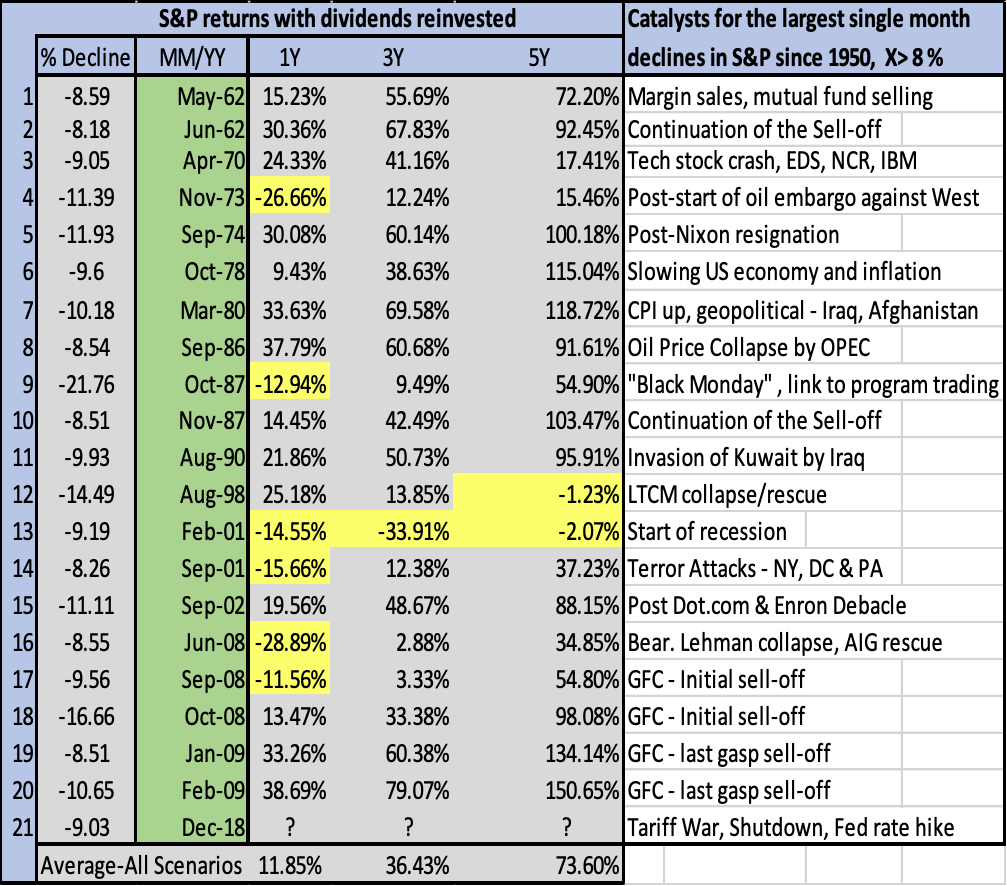
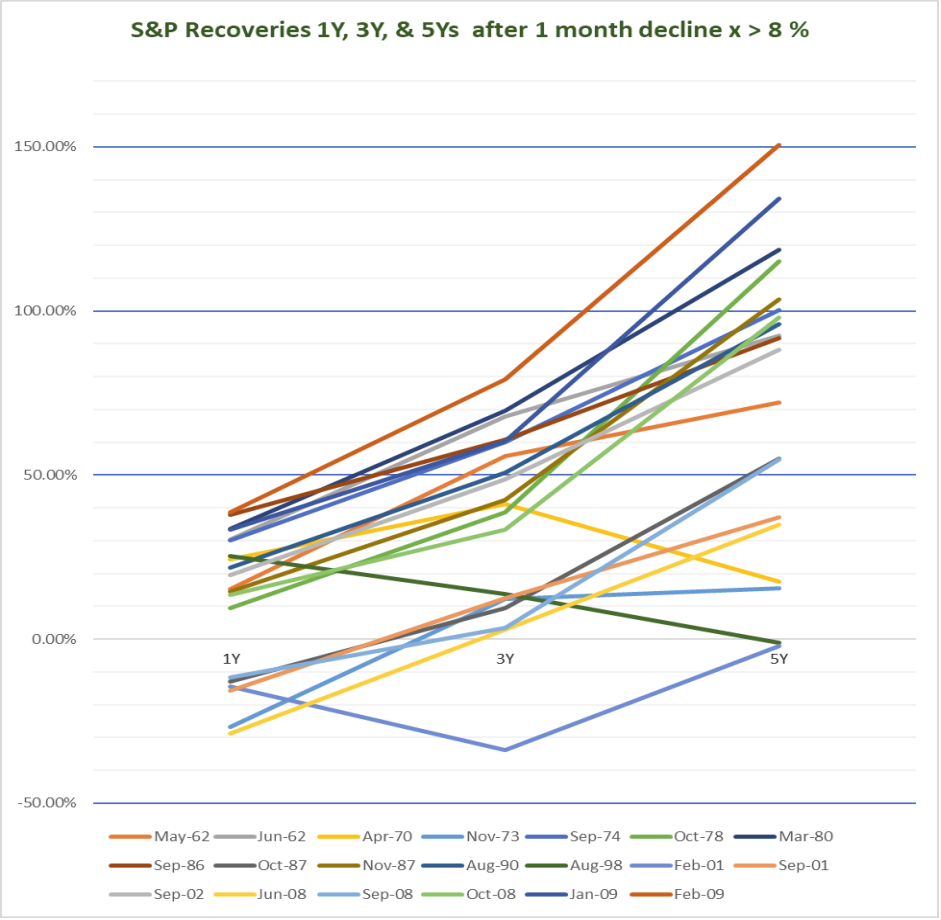
Largest One Month S&P Declines and Subsequent 1Y, 3Y, and 5Y Returns

Given the magnitude of the S&P Sell-off in December 2018 (-9.03 %), we thought it would be instructive to examine past events of a similar magnitude. We selected all single month sell-offs since January 1950. Here is a table and graph of our findings.

No one can predict what the future holds but certainly as one wag put it, “we’ve been to this picture show before.” Large drops in equity prices over a one month horizon are a temptation to take drastic action. Investors tend to become emotionally involved with the market and it is difficult to remain disciplined. What is critical is that investors build portfolios that are resilient to market corrections and achieve the best long-term risk adjusted returns. We present the historical data for the reader’s own interpretation.

Want to learn more? Please contact Chris Cutler, Tom Donahoe, or Safia Mehta at 917 287 9551.

Avoiding High Costs of Transitioning Assets to a new OCIO

A major utility company’s service promise is “We’re on it!” A new OCIO will say the same thing. In fact,
most OCIO’s have dedicated teams that arrange new client onboarding. From personal experience, the
process is problematic, and the transition tends to leave client’s money on the table. This could easily
cost the Foundation up to 1% or more in value of its corpus.

Here’s why – Once a client gives “walking papers” to the existing OCIO, it is essentially “pencils down.”
Cooperation often tends to decline; it’s just human nature. Likewise, a new OCIO may assert that they
do not own the performance until the assets hit the new custodian’s books at the new OCIO. This
potential material gap in performance is owned by the client. Here are typical stages in a transition and
miscommunication often leads to process delays.

Manager Analysis Services can help you avoid those costs by acting both as your search consultant
and as your transition consultant.

Documents Needed by New OCIO Team (partial listing)

-Articles of Incorporation, EIN Document, IRS Letter of Determination
-Bylaws, List of signatories, etc.
-Existing Investment Policy Statement and Asset Range Grid (both subject to editing by new OCIO)
-Board resolution confirming appointment of the new OCIO

Critical Handling of Your Assets

Which assets will be sold, when and how, and how will proceeds be transferred?
Which assets can be transferred electronically? (ACAT)
Which assets will follow over time? Proper timing sequence.
Transition Allocation: Will proceeds and assets be transferred over “as is” to the new OCIO? Will
there be a reallocation by asset class amidst the asset transfer process?

Special Instructions

Who are authorized signatories to transfer of proceeds or assets from old OCIO with new (i.e. nonstandard) wire instructions that the custodian will need to verbally confirm via call backs?
Depending on the sequence and settlement dates, will the Foundation be out of the market (wholly or
partially) for 1 or more days? Will the new allocation occur over time or be “averaged” into the market,
or fully deployed ASAP? (You should insist on a detailed transition plan and probe for gaps/errors.)

Reconciliation of all Transactions in Anticipation of EOY Audit Review

If you do not take steps to have all the transfers and liquidations, etc. reconciled within a few weeks
following the transfers, you are inviting future headaches, costly reconstruction of data, etc. Auditors
have a laser-like focus on these large transactions, given the absolute size relative to total assets, as well
as margin for significant error and losses.

Want to learn more? Please contact Chris Cutler, Tom Donahoe or Safia Mehta at 917 287 9551